
How Bench Warrants Work in Alexandria City
People say "bench warrant," but a Virginia court record may use another name for the same idea: arrest process a judge directs after a missed appearance or a broken order. You might see "show-cause summons," "capias," "Capias: Attachment of the Body," or an arrest warrant charging failure to appear. The label depends on the case. It also depends on what the judge did that day. In Alexandria City, the courts split the work. General District Court takes adult traffic and misdemeanor matters plus felony preliminary hearings, while Circuit Court handles felony trials and criminal appeals. JDR covers juvenile, family, support, and certain adult domestic cases, and each court controls the process in its own file. Before calling, find the case number and court on a summons or an OCIS entry. The clerk can walk you through the docket event but cannot give legal advice about what you should do.
Bench Warrant or Virginia Capias?
The formal term tells you what the Alexandria City court actually ordered. A capias is arrest process tied to violating a court order, while a show-cause summons directs a person to come in and explain alleged noncompliance. A failure-to-appear arrest warrant can charge a separate offense under Virginia law.
| Process | Common Trigger | What to Confirm |
|---|---|---|
| Show-cause summons | Alleged violation of an order or condition. | Appearance date and issue for hearing. |
| DC-361 capias | Missed appearance, payment, order, support, probation, or other reason. | Reason, bail direction, and return court. |
| FTA arrest warrant | Failure to appear under the applicable statute. | Underlying case and whether a new charge appears. |
These terms are not interchangeable. Read the case event, then ask the Alexandria City issuing clerk which process is still in effect. For the split between a new charge-based warrant and FTA process, see Alexandria arrest warrant procedures.
Bench Warrant Issuance in Alexandria City
Several things can push an Alexandria City court to issue process: a missed court date, broken release terms, an unpaid fine or costs where authorized, failure to obey an order, probation or VASAP noncompliance, or another show-cause reason. Virginia Form DC-420 lists these grounds on a request for show-cause summons or capias. Note what the form is. It is a party's motion, not a form any defendant can file to cancel a warrant. Where you take the question depends on the case, because GDC criminal matters go to the criminal clerk while traffic cases go to the traffic clerk, and Circuit and JDR run their own procedures. One more caution. A docket entry can also record a continuance or a recall, so an unexplained status term does not mean a new warrant exists. Ask the issuing court directly whether an appearance, hearing, motion, or counsel is needed.
DC-361's Failure-to-Appear Fields
Virginia's DC-361 form shows why a capias ties to one specific underlying court matter. The fields can capture the court and case number, the reason for process, a missed appearance date, a missed payment or due amount, a violated order, support arrearage, probation or VASAP grounds, and bail direction, plus issue, arrest, officer, agency, and next hearing details. The reason and bail boxes answer different questions. So do not read "capias" as shorthand for unpaid fines, and do not assume a bond amount from the word alone. The current order and the clerk's case-specific record control. Official form names appear in the Virginia District Court forms index and on its criminal forms page. Alexandria City publishes no public sample capias list and no fixed warrant-number pattern. And remember the form number is not a warrant or case number.
How Bench and Arrest Warrants Differ
A bench or FTA process grows out of a duty an Alexandria City court already imposed. An arrest warrant starts differently, with a complaint and a probable-cause review of an alleged offense. A person can face both at once: a new charge, then process after a missed court date.
| Feature | Bench or FTA Process | Arrest Warrant |
|---|---|---|
| Trigger | Missed setting or alleged noncompliance. | Complaint and probable cause. |
| Record path | Underlying docket plus court process. | Criminal complaint and warrant record. |
| Issuer | Court handling the underlying case. | Authorized judge, clerk, or magistrate. |
| Next step | Ask the issuing court about appearance or recall. | Ask counsel and the issuing court about process and bond. |
For the separate criminal-warrant process, use the arrest warrant page.
Traffic FTA Is Not Always an Arrest Warrant
Virginia treats a traffic infraction and a traffic misdemeanor differently, and that shapes what a missed date means. Under § 19.2-258.1, the court may hear an ordinary infraction in the person's absence after notice, and it shall not issue an arrest warrant for that absence under § 46.2-938. A traffic misdemeanor is different. It can generate FTA process under § 46.2-938 and § 19.2-128. Skipping an infraction is still not harmless. The court can decide the case without you, and fines or costs may remain. The Alexandria General District Court Manual explains the infraction and misdemeanor split, and the traffic clerk handles a traffic docket rather than the criminal clerk. Read the charge classification and the docket event before assuming what happened. Check the Alexandria General District Court schedule for local court hours and contact information.
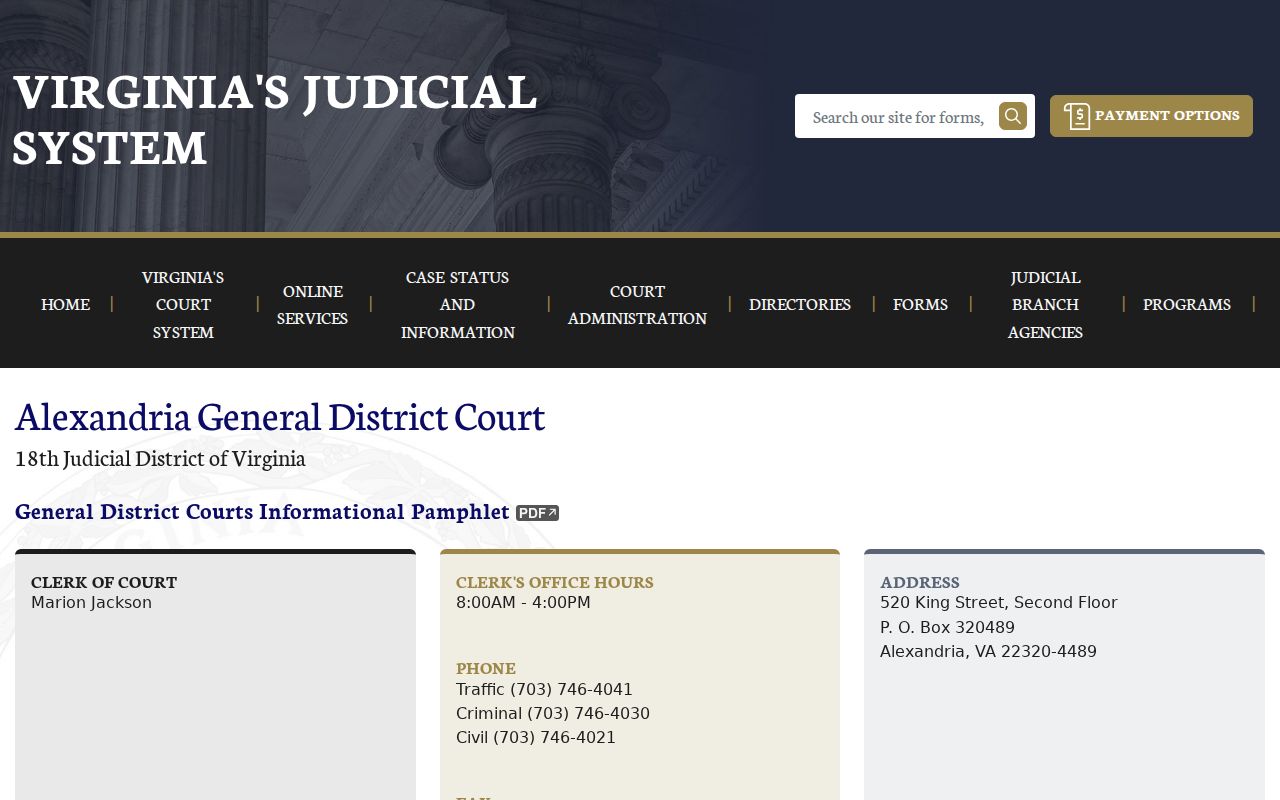
For any traffic setting in Alexandria City, the court's own schedule and clerk contacts are the place to verify it.
Clearing a Bench Warrant in Alexandria City
Clearing an Alexandria City bench warrant starts with the case record: find the court and the process type. Then call the clerk and ask what the court wants, whether an appearance, a show-cause hearing, a motion to recall, payment, or an attorney. GDC criminal is 703-746-4030; GDC traffic is 703-746-4041; Circuit Clerk is 703-746-4044; JDR is 703-746-4141.
- Use OCIS or the local GDC system to identify the case and court.
- Call the issuing clerk and ask what process and next date appear on the docket.
- Ask counsel whether a motion, court appearance, or surrender plan fits the case.
- Use the form the clerk or lawyer identifies; DC-323 is listed as Recall of Process, while DC-420 requests show-cause process.
- After the court acts, obtain docket or written confirmation and check the underlying case separately.
Caution: The public sources do not promise a booking-free walk-in. Confirm the court's instructions and get legal advice before surrendering.
DC-420 Is Not a General Recall Form
Form DC-420 is titled Motion for Show Cause Summons or Capias. It is not a general warrant recall form. A party uses it to ask for court process when a suspended sentence was violated, when payment was missed, or when an order, VASAP, probation, or a deferred proceeding was not followed. For cancelling process outright, the statewide district criminal forms list carries DC-323, Recall of Process. Ask the Alexandria City clerk which form fits and how the court wants it filed. The Circuit Court has its own local motion procedures plus a chambers line for scheduling, though court staff cannot help fill out legal papers. The DC-420 form lays out the requester's case, contact details, reason, facts, and signature. In the end a judge rules on the motion. Filing it, or paying a fee, does not itself prove the warrant was recalled. Keep the stamped order or docket entry after the decision.
Alexandria City Courts That Issue Bench Warrants
One courthouse in Alexandria City, but each court inside controls only its own cases. General District Court sits on the second floor at 520 King Street. The Circuit Court clerk works from Room 307. Juvenile and Domestic Relations is on the first floor. Separately, District 18 magistrates staff the Adult Detention Center at 2001 Mill Road around the clock for initial warrant and bail decisions. The Alexandria GDC page splits its traffic and criminal contacts. Circuit matters go through the Circuit Clerk, and JDR questions go to that court's clerk, where juvenile confidentiality rules apply. Only the issuing court decides recall. The Sheriff's service office cannot do it. If you missed a court date, write down why and ask the clerk how to present it. Illness, transport trouble, and similar facts may count, but the judge rules on good cause. When you ask about a reset or recall, give the exact court name and case number.
Alexandria's Mill Road Magistrate Route
An arrest or a surrender in Alexandria City can lead straight to magistrate review at the William G. Truesdale Adult Detention Center, 2001 Mill Road. District 18 magistrates handle the first warrant and bail decisions there. That desk is separate from the clerk counters at 520 King Street. It is not a warrant-clearance window. For someone in custody, the Sheriff posts 703-746-5000 for charge, bond, and court-date details between 6:00 a.m. and 6:00 p.m. After hours, call 703-746-5050. A 24-hour center line, 703-746-4099, also runs. The Sheriff's contact directory and the District 18 magistrate listing describe these separate roles. Alexandria publishes no public bond schedule and promises no walk-through release. Confirm the logistics with counsel or the court before you go.